

Printed fromChabadDowntown.com
Ask the Rabbi
Subscribe
Subscribe to Shabbat e-mails
View all subscriptions »
Contact
Home
About
Sign In
Chabad of Downtown Spreading Goodness and Kindness
Calendar Ad Campaign Minyan Times Join our Mailing List! Local Info Shabbat Meal Reservation Partnership Form Hebrew School Chabad Survey Photo Gallery Mi Sheberach Food Pantry In the News Chabad-Lubavitch Directory
Places to Stay Kosher in S Diego Shabbat Meal Reservation Local Chabad Centers Mikvah Israel Kosher Meals Jewish Burial/Cemetery Chai Club
Chabad Photos Hakhel YY Jacobson Lecture An Evening with Holocaust Survivor, Joseph Alexander Purim in Paris 2022 CommUnity Torah Dedication Purim in the 20s Gala Dinner 15th Anniversary Grand Chanukah Celebration 2019 City Hall Menorah Lighting 2019 Menorah Lighting at Liberty Station
Bar Mitzvah Gala Dinner 2017 Gala Dinner Celebrating A Decade of Dedication BRUNCH Fundraiser Siyum Sefer Torah Israel Trip 2011 Adult Education Women's Circle Kosher Comedy Nite Chanukah Soiree 2015 Chanukah at the Headquarters
Shabbos Project 2015 Subs in the Sukkah July 4th Fireworks Our Shul Lag B'Omer BBQ 5775 Pop-Up Chanukah Soiree Mezuzah Dedication Shofar Factory Lag B'Omer Parade JYA Chanukah Soiree
The Metropolitan Chabad The Superhero Wore Tefillin At San Diego Comic-Con, a Time Out for Shabbat The Fifth Question: Where to Celebrate Pesach? Birthright: Open Seders Run for the Hungry Around in the Year in Song Benny Friedman Concert Concert Press Release Hebrew School Ad
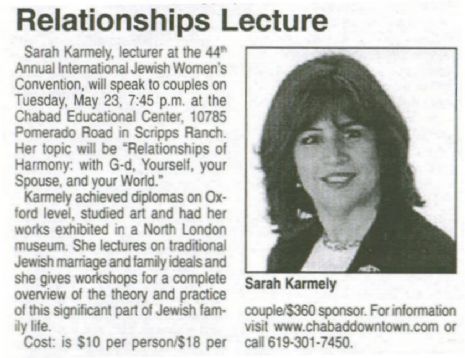
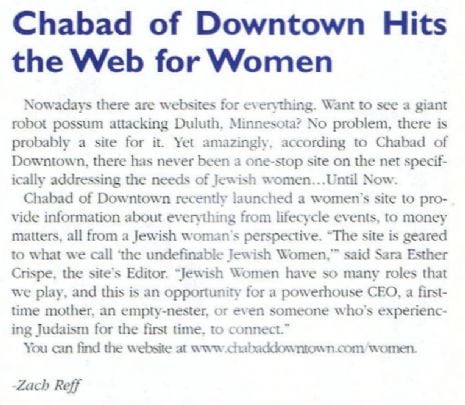
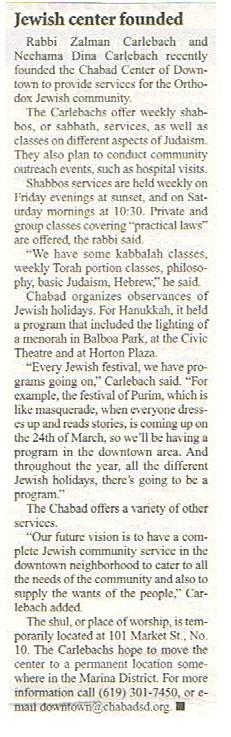
Wildfires Test Californians’ Resolve New Hebrew School Opens New Torah Studies Course Downtown Relationships Lecture Chabad Hits the Web for Women New Location for Chabad of Downtown First High Holiday Services Jewish Center Founded
Global Directory Event Directory Campus Directory Hebrew Schools Camp Directory Bar Mitzvah Services Find a Bat Mitzvah Club
Information
Weekly Classes Lecture Series Rosh Chodesh Society 5786 Study Session with the Rabbi Online Jewish Resources Previous Classes Lunch & Learn Hebrew Reading Pirkei Avos
RCS 5786 Class Descriptions
Magazine Parshah (Weekly Torah) Jewish Calendar Jewish Holidays Community & Family Mitzvahs & Traditions Lifecycle Events Essentials Chassidic Thought The Jewish Woman
JewishKids.org Audio Classes Chabad.org Video Texts & Writings Knowledge Base Ask the Rabbi Chabad Centers and Synagogue Directory TheRebbe.org Jewish News
Rosh Chodesh Society Responding to The New Age AntiSemitism An Evening with Holocaust Survivor Joseph Alexander Military Rabbis JLI Torah Studies This CAN Happen Facebook Lectures Son of A Nazi From Prisoner to President UnOrthodox with Sara Berkovic
Jewish Daughter of Hamas Moshiach Series Lecture & Book Signing Ballerina of Auschwitz Lecture Judaism 101 MatchMaker: Make Me A Match Faith. Family. Future. Lecture - A Jewish Land Passover Redefined Global Unity Event
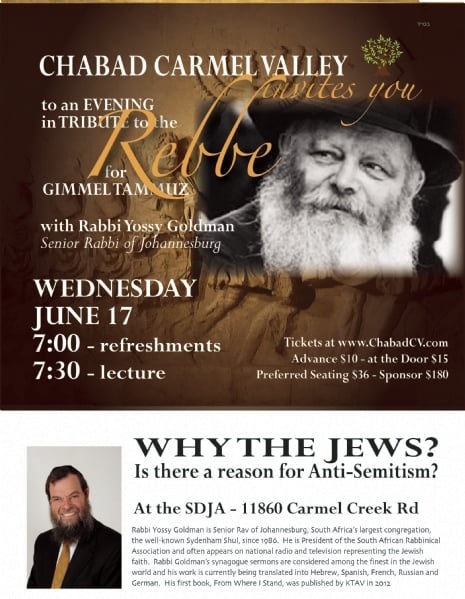
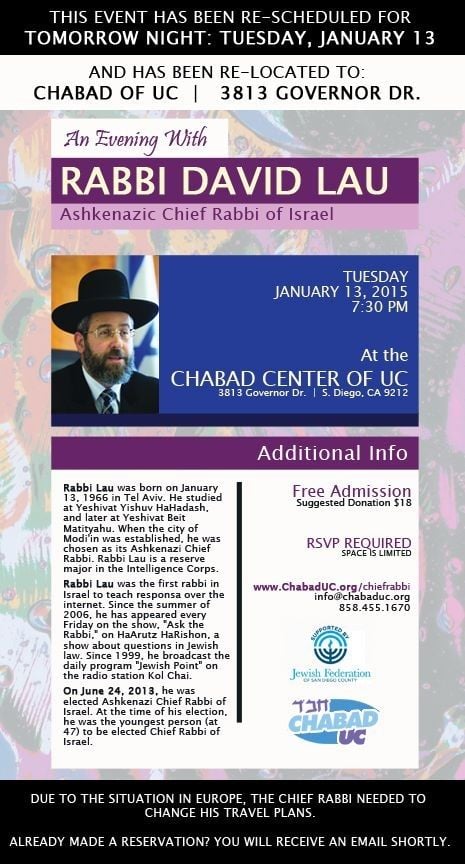
An Evening with Cary Nelson Buddhist Monk turns to Kabbalah Why the Jews? Archaeological Claim to Jerusalem Chief Rabbi Lau Happiness Lecture Tribute to the Rebbe Lecture: Judaism & Transplants Kabbalah of Character Health & Vitality
Adult
Education
Partnership
Chai Club Form Kiddush Sponsorship Memorial Board Sponsorship Opportunities Dedication Opportunities Torah Dedication Planned Giving Ralphs Community Program Year-End Campaign
Why Giving Matters Ways To Give Gratitude Resources Contact
Donate
Shabbat Meal Reservation Rosh Chodesh Society 5786 Shavuos 2026 Lunch with the Rabbi JWC Wooden Vase Workshop Jewish Book Club Torah & Tequila Past Events
RCS 5786 Class Descriptions
Torah Dedication Gala Dinner Holiday Events Chabad Lecture Series Women's Circle Social Events Young Adults Night Hugs for Hostages Calendar Ad Campaign Cultural Club - That's So Jewish
Gimmel Tammuz Farbrengen National Jewish Retreat Met@Chabad Event Lunch Social Young Adults Shabbat Dinner Yud Shvat Farbrengen JLI Trip to Israel 2020 Kol Esperanza Concert Evening of Tribute to Rebbe Art Exhibition
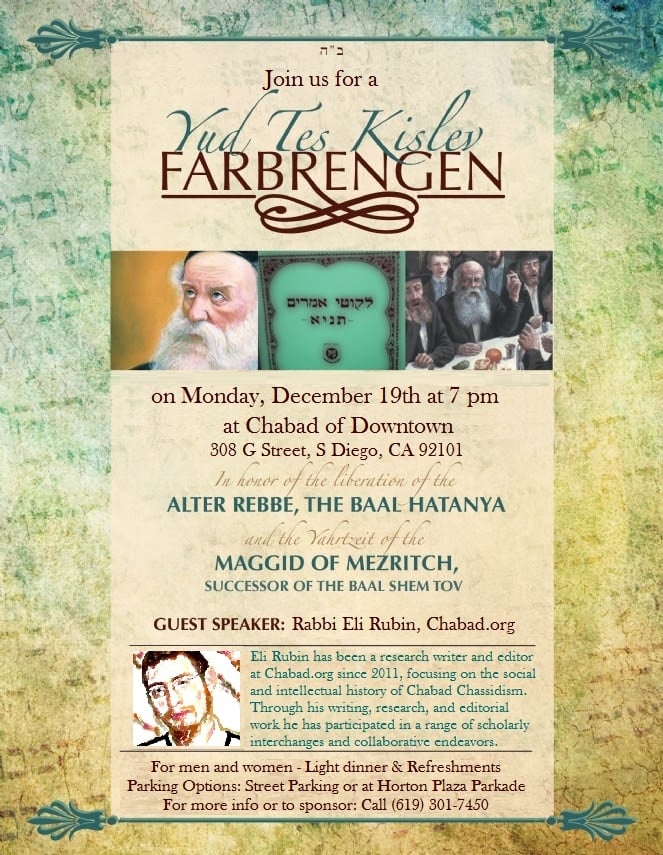
Comedy: Elon Gold Summer BBQ Chassidic Pop Art Yud Tes Kislev Farbrengen Shabbos Project 2016 Escape Room SD High Holiday Matching Campaign Bone Marrow Drive National Jewish Retreat Segway Tour
Events
Donate
About Search Contact
ב"ה
KabbalaOnline.org Basics History of Kabbalah

Authenticity of the Zohar

 Beginner
By Moshe Miller
The Zohar's Mysterious Origins
Was It Really Written by Rabbi Shimon bar Yochai?
The Book of Zohar, the primary text of the Kabbalah, contains the teachings and doings of Rabbi Shimon bar Yochai and his disciples, who flourished in the Land of Israel in the second century.
26 Comments
Arguments of the Skeptics
Comments from "Higher Criticism"
6 Comments
Responses to the Claims of the Skeptics
Review of the critics...
9 Comments
Other Claims and Responses
They weren't doing their homework....
5 Comments
Other Claims and Responses (Continued)
Torah vocabulary and ideas...
17 Comments

Join the Discussion

15 Comments
Newest Oldest
Posting Guidelines
characters remaining
Webmaster via kabbalaonline.org March 5, 2012

To: Anonymous in Brooklyn To learn more about Zohar, you can start in our Zohar folder. Just click on "Classic Kabbalah in the left menu on any page Reply

Anonymous brooklyn, ny March 3, 2012

zohar I wish to learn more about the zohar. How can I do that online? Reply

Anonymous Tzefat via kabbalaonline.org March 9, 2011

Re: bar-ben Bar Yochai is used sometimes in Midrash too and even occasionally in the Talmud. And more often simply "Rabbi Shimon" and sometimes "Rashbi" where the 'b' can be 'ben' or bar'. Reply

H May 7, 2023
in response to Anonymous:

1. in aramic bar means the same thing as ben. 2. even in hebrew the word בר can be an acronym for "the son of Rabbi..." Reply

David דוד Reghay Flushing February 27, 2011

why "bar" and not "ben"? I believe in the authenticity and holiness of the Zohar, but I have always wanted to know why in the Gemara Rashbi is always referred to as Shimon "Ben" Yochai and not Shimon "Bar" Yochai as he is called by the Zohar. After all, the Gemara is also written in Aramaic yet uses the Hebrew word for son. Are there perhaps other ancient sources such as Midrashim that also use the term "bar"? Thanks, I've searched a lot of the answer to this question and have not been able to find one! Reply

פגל משיח October 15, 2022
in response to David דוד Reghay:

מגילה יב"ב, יט"א, שמו"ר ב, ו, תמחומא ויקהל א, א, רות רבה ז, יג, איכה רבה א, כג ונד, וכו Reply

webmaster Tzefat, Israel via kabbalaonline.org December 31, 2010

Zohar from beginning Go to our Zohar section under "Classic Kabbalah" Reply

Zapata via kabbalaonline.org December 20, 2010

Learning i wish learn more of zohar from begining Reply

Yosef via kabbalaonline.org December 20, 2010

Thanks This is a true service to our people. Thank you for this incredibly important work. Reply

Rabbi Yerachmiel Tilles June 8, 2010

Reply to JIF from R. Moshe Miller I believe that since the publication of several works by Professor Moshe Idel (current head of Dept of Jewish Mysticism and Kabbalah at the University of Jerusalem) much of Scholem's work on the Zohar has been called into question. Interestingly, Scholem himself wrote a treatise explaining why Moshe de Leon could not possibly have been the author of the Zohar. He suddenly changed his thesis when appointed the head of dept of Jewish Mysticism, without ever disproving his previous proofs. There are those who suspect that he changed his opinion in order to capture that post.
You are right; I could have used more measured tones. Attribute that to the passion of youth. Reply

Josef I Friedman Hillsborough, NJ May 2, 2010

Some Comments on Your Articles As I'm sure you're aware and have even alluded to, Scholem's main conclusion that de Leon is the main author has continued to be accepted although certain details of his analysis have rightly been questioned (such as the quality of the Zohar's Aramaic), as we'd certainly expect in any scholarly exercise. Some of your comments on individuals, seem overly harsh. Reply

Rabbi Yerachmiel Tilles October 16, 2009

reply to Art Millerfrom R. Moshe Miller, part 2 In any event, review the verses in Bamidbar 17:11-13 and see the Targum Onkelos and Yerushalmi. This, my friend, is the origin of the phrase itbasma dina – when Aaron was told to use the incense (busmin or busmaya in Aramaic – itbasma is the verb form) to mitigate the plague which was causing people to die – i.e. to overcome the harsh decree with incense [or in general with good deeds that are “a pleasing scent to Hashem”] (which a better translation of the phrase itbasma dina). Why Scholem finds it necessary to dig up some extremely unlikely connection to Spanish instead of looking first and foremost in Jewish literature, I don’t know. Perhaps he had an agenda?

All the best.
Rabbi Moshe Miller Reply

Rabbi Yerachmiel Tilles via kabbalaonline.org October 16, 2009

reply to Art Miller from R. Moshe Miller, part 1 I know of no Spanish in the Zohar at all, other than the very dubious claims to the Spanish origins of a couple of words (no more than that!) that Scholem makes in his Major Trends p. 165.

One of those words Scholem believes is spanish in origin is “gardin” (see Major Trends p. 165 footnote 43). How then does he explain the existence of the word in Masechta Avoda Zara 26a and Yalkut Shimoni Vayishlach remez 133 which have the same meaning there as the word in the Zohar eg. Vol. 3 63a? Perhaps Scholem was no expert in the Gemara or in Midrash but he could at least have checked in a Concordance!

The second example Scholem cites (footnote 44) is itbasma dina, usually translated as “to sweeten judgments” or harsh decrees, which he claims comes from the Spanish endulzar. He adds that the Hebrew phrase hamtakat hadin is of much later origin. But a similar phrase (not identical, true, but similar enough, and IN THE SAME SENSE) is used in Bamidbar Rabba 10:3; Mechilta Beshallach 15 and in Talmud Yerushalmi Avodah Zara 2:8. Reply

Ben New York February 26, 2018
in response to Rabbi Yerachmiel Tilles:

in response to Rabbi Moshe Miller via Rabbi Tilles You are referring to the wrong "gardin." It is the word "gardini" Zohar 1:34a:6 which translates to guardian angels. This is clearly Spanish. The "gardin" that you brought down from Avodah Zara 26a and Yalkut Shimoni is referring to a weaver and not an angel. And other places in Shas that prong down the word "gardin" and other words with the same root are all referring to weavers and not angels. Reply

Art Miller Baltimore, Maryland via kabbalaonline.org September 11, 2009

Spanish words found in the Zohar Dear Rabbi Moshe Miller:
Will you tell me why Spanish found its way into the Zohar? The earliest mention of the Spanish language used verbally or in written form was that it was an ougrowth of Vulgar Latin in the Fifth Century, or that it became a "language" in the 9th Century around the time of Charlemagne, and Rabbi Shimon and his colleagues apparently "wrote" the Zohar in the second century when hiding from the Romans, and were living in an area far, far away from Spain -- across the Mediterannean Sea, I believe. Thank you. Reply

Basics
What is Kabbalah?
History of Kabbalah
Timeline of Kabbalah
Authenticity of the Zohar
Biographies of Major Kabbalists
First Steps
Recommended Resources
FAQ's

The larger, bold text is the direct translation of the classic text source.

The smaller, plain text is the explanation of the translator/editor.
Text with broken underline will provide a popup explanation when rolled over with a mouse.

Programs
Synagogue Services
Adult Education
Shabbat Meals

Join us for a special shabbat experience

Holiday Celebrations
Women's Events
Community Services

Chabad of Downtown
275 Island Avenue S. Diego, CA 92101
619-289-8770

Powered by Chabad.org © 1993-2026 Privacy Policy